
3B60.20 • Wave Motion Visualizing Sound
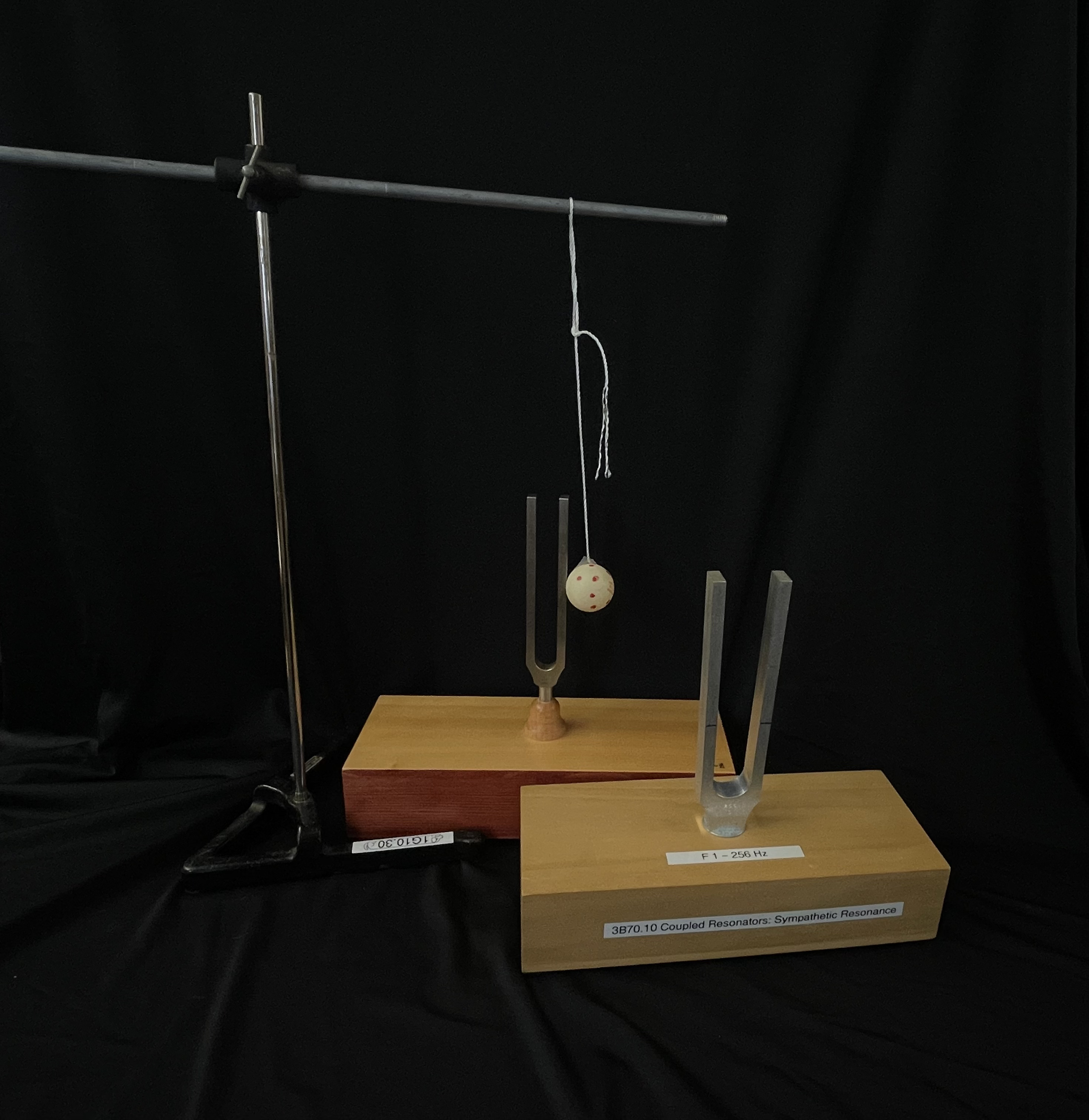
Concept:
- Two tuning forks with the same frequency: when one is struck, the other begins to vibrate and produce sound even without being struck.
- This demonstration visualizes resonance by showing how matching frequencies allow energy to transfer and induce vibration in another object.
Instruction/Notes:
- Set up two tuning forks with the same frequency on separate stands and place them close to each other without touching.
- Attach a light string to the second tuning fork (the one that will not be struck) and tie a ping-pong ball to the end of the string so that it hangs freely near the prongs. This will be used to visualize vibration caused by resonance.
- Strike the first tuning fork gently with a rubber mallet to make it vibrate and produce sound.
- Observe the ping-pong ball attached to the second tuning fork. If resonance occurs, the ping-pong ball will begin to move, indicating that the second tuning fork is vibrating even though it was not struck.
- Next, replace the second tuning fork with another tuning fork that has a different frequency and attach the ping-pong ball in the same way.
- Strike the first tuning fork again and observe the ping-pong ball. Little to no movement should be seen, demonstrating that resonance does not occur when the frequencies do not match.
Note for staff:
- For the setup, prepare three different tuning forks:
- Two with the same frequency
- One with a different frequency
- Make sure the ping pong ball is touching the tuning fork.
Last updated on April 23, 2026